SX4
Designed to express Suzuki's sporty compact and lightweight-SUV heritage. The first European lineup included Outdoor and Urban design treatments.
 MUSEUM
Design exhibit
Follow the Suzuki–Fiat partnership from its first agreement to the production line in Hungary.
01 / THE PARTNERSHIP
On April 10, 2003, Suzuki Motor Corporation and Fiat Auto announced a memorandum of understanding in Budapest to jointly develop a new five-door SUV. Their plan called for gasoline and diesel powertrains, distinct exterior styling for each brand, and production at Magyar Suzuki's Esztergom factory in Hungary.
Suzuki and Fiat intended to distribute their versions independently. What emerged was not simply a badge swap: the Suzuki SX4 and Fiat Sedici shared a fundamental vehicle program, while the manufacturers deliberately differentiated the cars' visual identities.
02 / THE PEOPLE BEHIND THE SHAPE
The SX4's design is associated with Italdesign and the Giugiaro family. The Giorgetto & Fabrizio Giugiaro Designers archive lists Fabrizio Giugiaro in its designer field while its project history describes the SX4 styling as the work of Giorgetto Giugiaro. Both attributions belong in the historical record; the available source does not clearly divide their individual responsibilities.
The archive identifies the SX4 as the Fiat Sedici's twin and notes the different front and rear treatments, while describing the dashboard as shared between the two vehicles.
Explore the designers' SX4 record ↗
The Italdesign founder whose name is closely tied to the SX4's exterior styling. This is a later portrait, not a photograph from the SX4 development years.
Photo: Mitjagodnic / Wikimedia Commons · CC BY-SA 4.0 · Display resized from source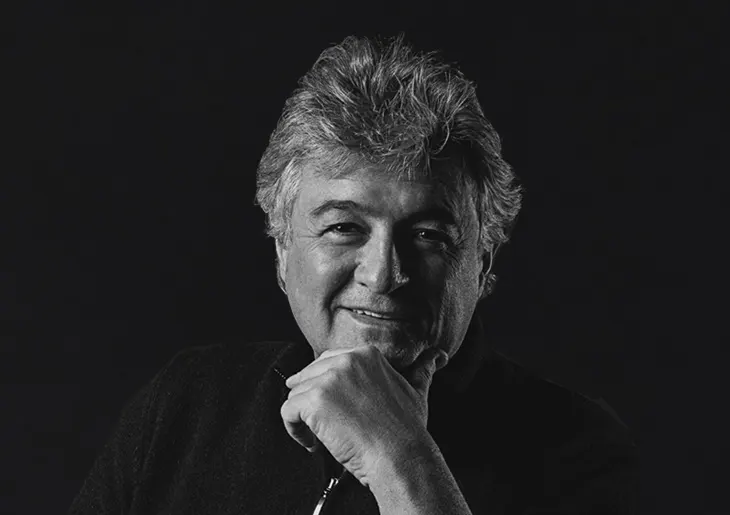
The Giugiaro designers' own project archive identifies Fabrizio in the SX4 designer credit. The archive does not specify an individual division of styling work.
Photo: Omni United (official portrait, locally hosted with permission)03 / DESIGN ANATOMY
Suzuki described the SX4 as a Sport X-over: a synthesis of the sporty compact and the SUV. Its distinctive form was not just a high roof and protective cladding. The official 2006 launch release explained how the beltline, front quarter windows, wheel arches, cabin geometry and switchable all-wheel drive worked together to establish the car's identity.

A 2007–2009 SX4 photographed in Sydney, Australia. This view reveals the roofline, upright cabin, raised ride height and distinctive triangular front quarter windows of the original compact crossover.
Photo: OSX / Wikimedia Commons · Public domain · Original photograph, locally optimizedLarge triangular windows ahead of the front doors, together with a rising waistline, established the SX4's distinctive wedge-shaped profile. Suzuki highlighted these elements in its launch announcement.
Source: Suzuki SX4 launch announcement, February 28, 2006.
04 / THE SIBLING
Designed to express Suzuki's sporty compact and lightweight-SUV heritage. The first European lineup included Outdoor and Urban design treatments.
Developed alongside the SX4 for Fiat's European range, with distinct exterior styling and a shared underlying program.
The Giugiaro designers' archive specifically describes front- and rear-bumper differences and a shared dashboard. The historical photographs below show how the closely related shapes received their own Suzuki and Fiat identities.

Suzuki's interpretation used its own face, bumper detailing and brand identity.
Photo: Bull-Doser / Wikimedia Commons · Public domain · Display resized from source
The Fiat-badged sister car was designed alongside the SX4, sharing much of the structure while using visibly different exterior details.
Photo: Corvettec6r / Wikimedia Commons · Public domain · Display resized from source05 / THE ROAD TO GENEVA
A joint five-door SUV development program, with differentiated styling and planned Hungarian manufacturing.
Suzuki identifies the SX4 as its third global strategic model. Period announcements describe a December production plan; this is distinct from the factory's later recorded first-car milestone.
Magyar Suzuki's official factory history dates the first SX4 rolling off the assembly line to this day.
The launch announcement sets out the Outdoor and Urban lines, interior packaging, engines and three-mode i-AWD system.
The SX4 appears publicly in Outdoor and Urban forms, alongside the SX4 WRC concept; European launch follows in March.
These are real photographed vehicles, not imagined early clay models. Each represents a different experimental branch of the SX4 story after the original design was developed.

An authentic photograph of the early SX4 WRC display car at the 2007 Montréal auto show. This is an exhibition car photograph, not evidence that the pictured car raced in a WRC round.
Photo: Bull-Doser / Wikimedia Commons · Public domain · Display resized from source
An orange open-air experiment based on the SX4 Sport sedan, conceived for surf culture and unveiled at the 2007 Los Angeles Auto Show.
Photo: Aaron / Wikimedia Commons · CC BY-SA 2.0 · Display resized from source
Suzuki's fuel-cell SX4 was announced for public-road testing in 2008; this is a 2009 engineering exposition photograph.
Photo: Comyu / Wikimedia Commons · CC BY-SA 3.0 · Display resized from sourceOriginal 2006 Geneva launch photography: Suzuki's period exhibition announcement ↗. This archive keeps period show cars distinct from later concepts and research vehicles.
06 / ENGINEERING INTENT
The early European SX4 offered a 1.5-litre gasoline engine, a 1.6-litre VVT gasoline engine and a 1.9-litre turbo-diesel, depending on version. Suzuki's three-mode i-AWD system used an electronically controlled coupling, and the Lock setting automatically reverted to Auto above 60 km/h. These figures describe the original European launch specification, not every SX4 sold worldwide.
07 / RESEARCH DESK
The museum distinguishes what manufacturers documented at the time from retrospective interpretation. Dates, design credits and specifications are attributed to their source, and market-specific equipment is not generalized to all SX4s.